Help articles
CATEGORY: Campaigns
Campaigns: Recurrent campaigns
.png)
The Recurrent campaign type allows you to either set up a repeating, scheduled campaign to send at a frequency of your choice. Examples include a weekly or monthly.
Creating a new campaign
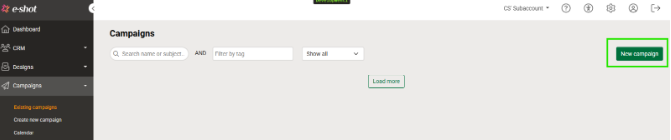
To begin creating a new campaign, click the ‘New campaign’ button in the top right of the page.
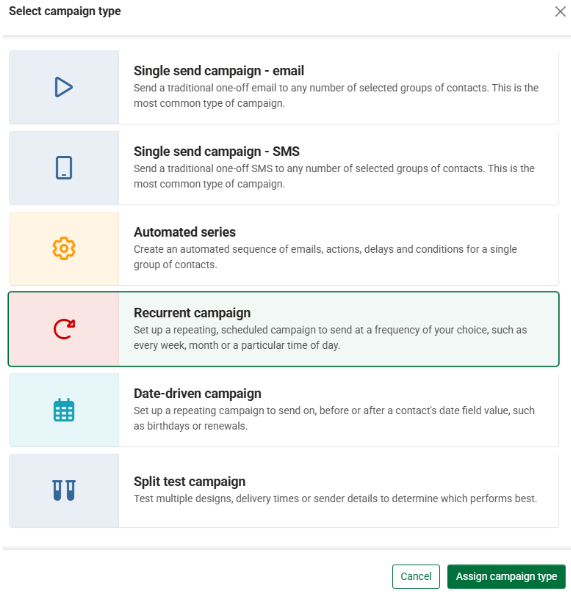
Doing so will bring up the below pop-up where you can choose the campaign type you would like to use. To choose your campaign type, you can either double click on a campaign type or single click then click the ‘Assign campaign type’ button.
Once you have assigned the ‘Recurrent campaign' campaign type, you will be taken to create a brand-new campaign like below.
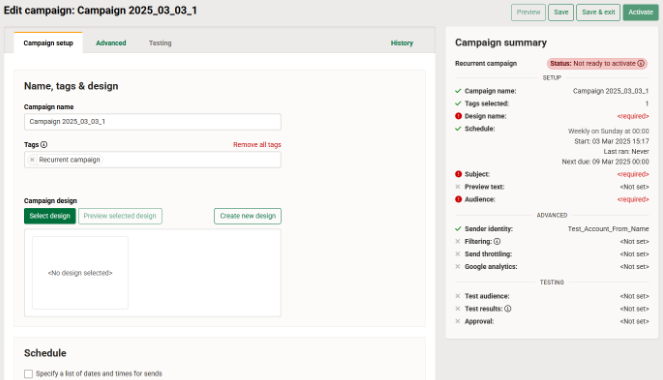
Campaign setup tab
To begin you can give your campaign a name (this is what you will see in the existing campaigns list and in analytics once the campaign has begun sending). The campaign name is only seen by e-shot users, but it is still important it is something you will recognise as it cannot be changed once the campaign has started sending.
You can assign any tags to your campaign. These can be seen on the campaign list view and are useful for filtering purposes. For the full details on tags, you can find out dedicated help article here.
Finally, you can assign a design you previously created to your campaign. To do this, click the ‘Select design’ button. Doing so will bring up a list of the recent designs available in your account.
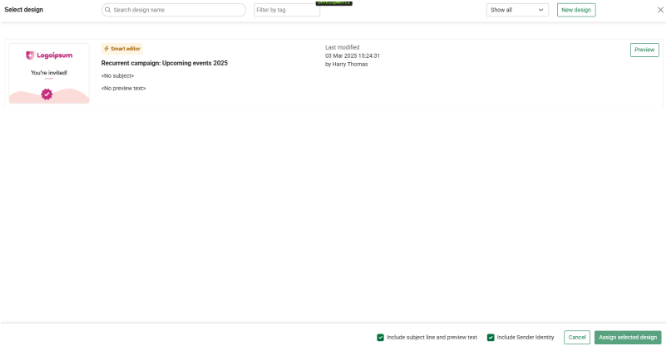
You will see the options ‘Include subject line and preview text’ and ‘Include Sender Identity’ these are automatically ticked. This will carry across those details that may have been set on your design (NOTE: You do not need to have these set on your design and they can be updated at any time within the campaign).
To assign your design, double click the design or single click and then click the ‘Assign selected design’ button. Once you have assigned a design you will be returned to the campaign.
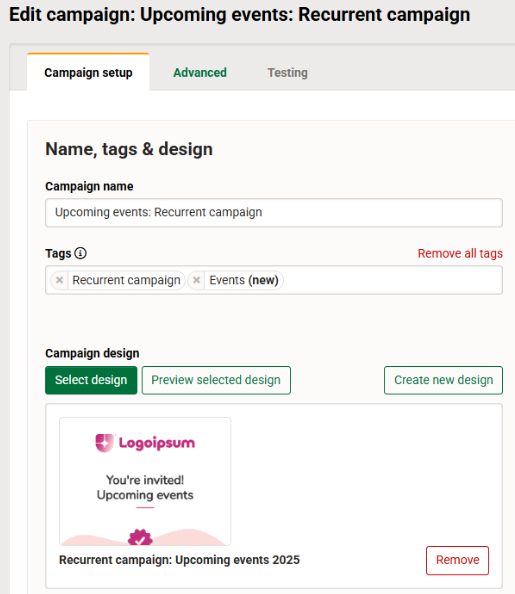
Your campaign should now be looking like the screenshot below, with the name, tags and design all set.
Schedule
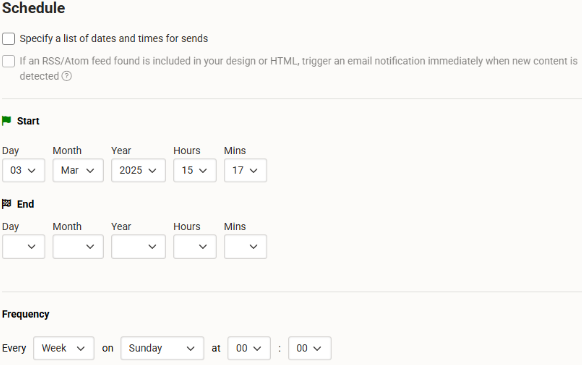
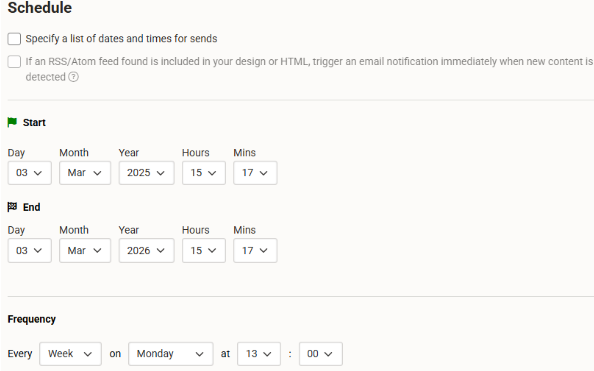
The schedule tab enables you to specify the start and end dates for your recurrent campaign, down to the minute, along with specifying the frequency of the campaign. You can also specify a list of dates and times for sends instead of a set repeating frequency.
If an RSS feed is included in your design, you can choose to trigger an email notification when any new content is detected. To setup a Recurrent campaign using RSS, please contact us via the live chat.
Let’s cover the options.
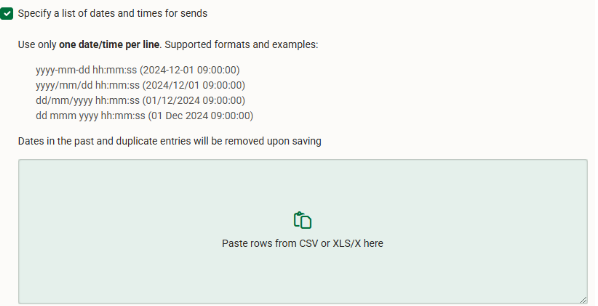
Specify a list of dates and times for sends: This allows you to specify the exact dates and times you’d like your campaign to be sent. This option is ideal if the frequency’s that are available are not applicable to you or you would want a different send time each send.
Please ensure you use only one date/time per line and that they are in the supported formats provided:
yyyy-mm-dd hh:mm:ss (2024-12-01 09:00:00)
yyyy/mm/dd hh:mm:ss (2024/12/01 09:00:00)
dd/mm/yyyy hh:mm:ss (01/12/2024 09:00:00)
dd mmm yyyy hh:mm:ss (01 Dec 2024 09:00:00)
If an RSS/Atom feed found is included in your design or HTML, trigger an email notification immediately when new content is detected: This option will only be available to you if you are using articles/RSS in the chosen email design. With this option an email will be sent each time a new RSS/Atom feed is picked up from the design.
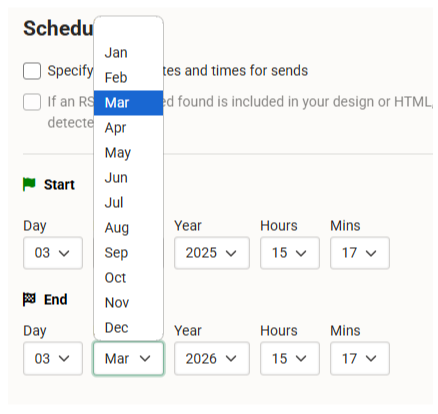
Start and end: This is simply when you want the recurrent emails to begin sending. A start date/time must be set but no end date is needed but can be set. To set your desired date/time, simply click each box and set what you’d like.
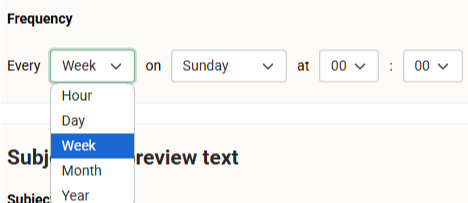
Frequency: Choose how often, on what day and time your recurrent campaign performs each send (if the specific dates/times have not yet been specified).
Example schedule setup: My schedule seen below is set to start on Monday 3rd March at 15:17pm, it will send every week on a Monday at 13:00pm. It will stop sending a year from the start date on the 3rd March 2026.
This means my first send would be the next Monday (10th March 2025) at 1pm and from then on would send every Monday at 1pm for the next year.
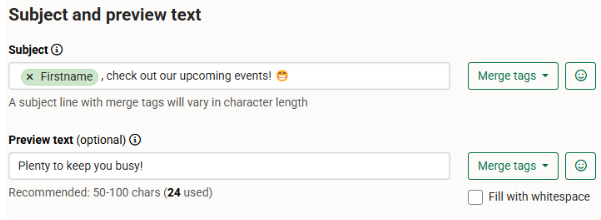
You can update your subject line and preview text, if it was pulled in from the design. If it has not been set, you can set it here as well. Only the subject line is mandatory, although we advise you also make use of the preview text.
For the full details on this section, view our dedicated help article here.
The final section under the campaign setup tab is ‘Audience’. Here is where you choose who your campaign will be sent to. You can send to a group, preference or both.
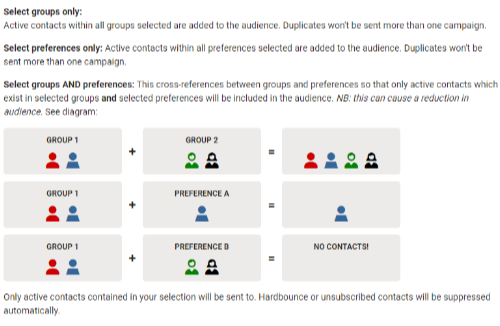
Your audience can be updated at any point up until your campaign is set live. We dive in deeper about Audiences in our help article here.
Advanced tab
The sender identity is where you can choose who your email comes from. It includes your sender email, sender alias and reply email.
As mentioned at the design stage, this will automatically be pulled into the campaign from the design if a sender identity was set beforehand. However, this can be overruled.
To do use the dropdown to choose one of the identities that has been setup.
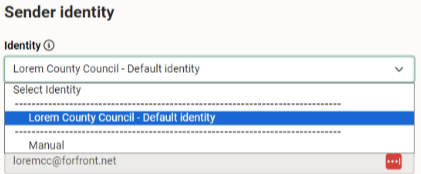
For the full details on setting and updating the sender identity attached to your campaign, find the dedicated help article here.
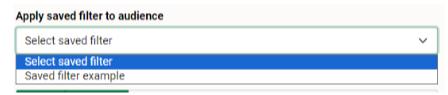
Audience filtering allows you to filter the audience you previously set. You can either filter using a sign-up form or a saved filter.
To apply a saved filter, first you will have needed to create a saved filter in the CRM section, you can find out how to do that here. Once you have your filter, use the dropdown, this will bring up a list of all the saved filters that are available for you to use.
To apply a sign-up form filter, click the ‘Select’ button. This will bring up all the active sign-up forms in your account. This will bring up the below pop up, where you can select and apply the sign-up form/s you would like to use to filter your audience.
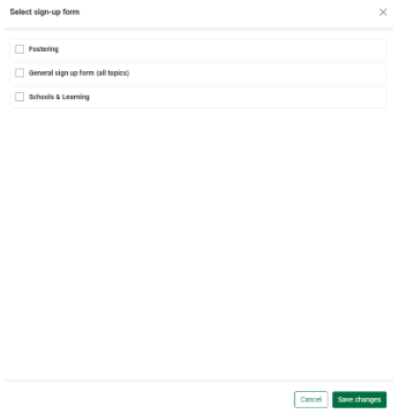
Similar to when you apply your original audience, once an audience filter has been applied, your audience size will be updated under the campaign summary. For the full details on applying audience filtering, find the dedicated article here.
The final section under the advanced tab, is the send speed of your campaign.
A send speed allows you to control how many emails will be sent per hour. This helps with deliverability and manageability for those larger sends.

To apply a send speed, first tick the box available, once you have done that, you will be able to specify the number of sends you would like to go per hour.
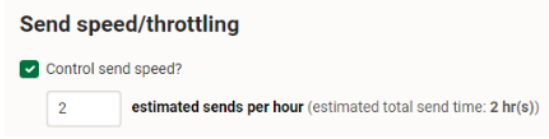
Once you have done this, you will see the estimated total send time for the campaign. In the above example sending to 4 contacts, 2 per hour means the campaign will be completed after approximately 2 hours.
For the full details on send speed, see our dedicated help article here.
Testing tab
Arguably the most important.
The testing tab allows you to send a test to either yourself or a select few contacts. This test email will appear the exact way it will to your contacts in their inbox, the only different being ‘[TEST]’ will be in front of the subject line.
Quick single send test
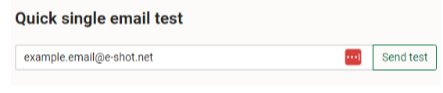
This test allows you to send a test to one email. The field will be prepopulated with the email you use to login to e-shot, meaning all you need to do is click that ‘Send test’ button.
Full test
This test allows you to send a test to any number of the test contacts that have been setup on your account. To perform this test, click the ‘Select’ button to choose your test contacts, tick the contacts you would like to receive the test and apply that audience by clicking the ‘Select test audience’ button.
Once you return, simply click the ‘Send test’ button to send a test to all the chosen contacts.
After a few minutes, you will be able to access the email forensics data for that test send. This allows you to view your test email in over 40 different email clients and devices.
For the full details on each of these areas, find our dedicated articles below.
History tab
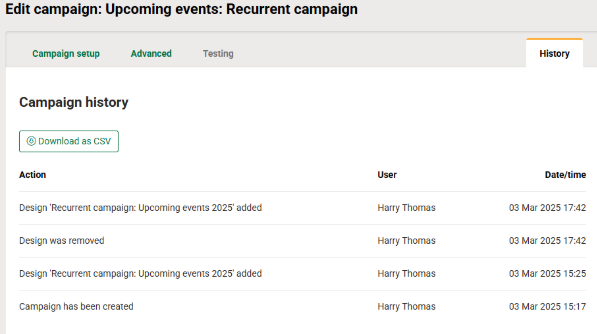
Who did what on this campaign?
The history tab gives you an overview of what user performed which action and when. These actions include updating a design or setting a schedule. Find out more here.
Campaign summary
The campaign summary always provides a quick overview of your campaign's setup. It auto updates as changes are made and lets you know everything you need to know, including if the campaign is ready to send.
An example can be seen below.
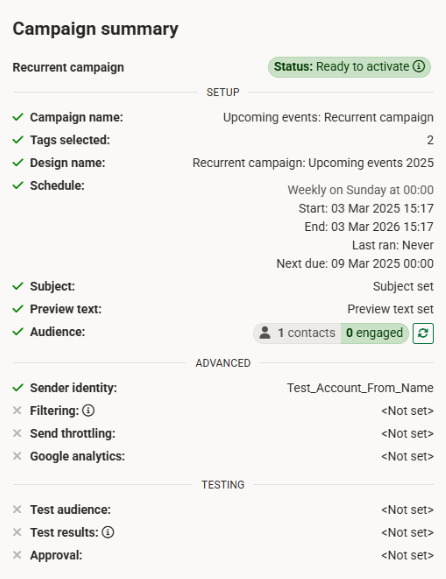
The schedule section will let you know key details such as when the next scheduled send would be after setting the campaign live.
Activating your campaign
There are a couple of ways you can activate your campaign. You can do this within the campaign when you can click the ‘Activate’ button if you are ready for the campaign to go live there and then.
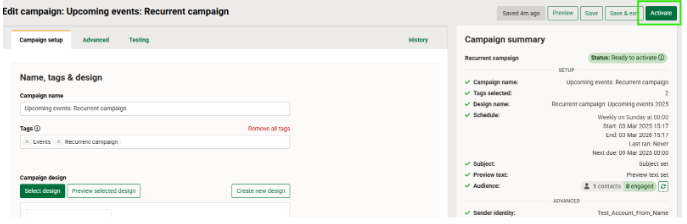
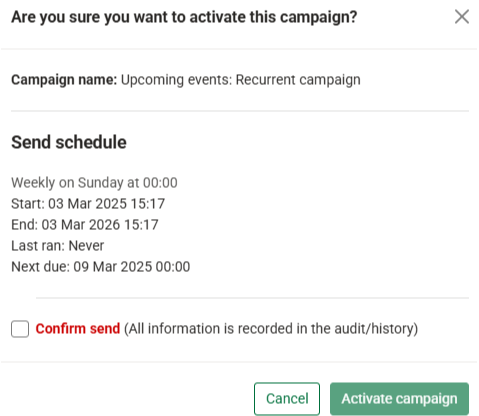
Doing so will bring up the below where you are asked to confirm the activation of the campaign. Here it will also let you know the sending schedule.
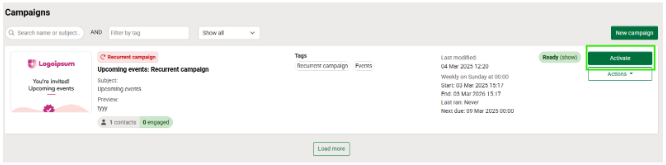
Or if you are not quite ready to activate the campaign yet, you can save and close and activate it from the campaigns list page at any time. Doing so from here will also ask you to confirm as per the above.
Managing and deactivating the campaign
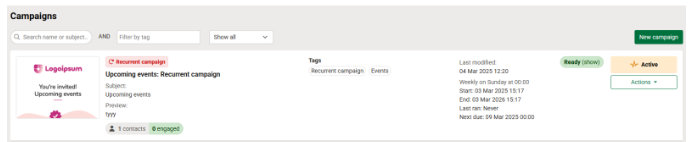
Once activated, the campaign will still be found in the campaigns list page as an un-editable ‘Active’ campaign.
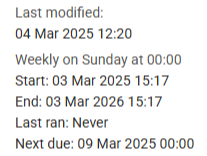
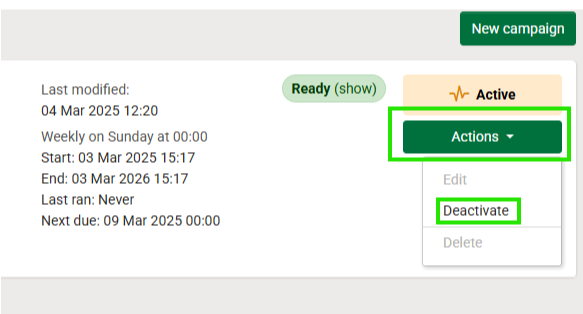
From the list view you are provided an oversight as to when the campaign will start and end. It will also include when it last ran and when the next send is.
Please note changes cannot be made once set live. However, if you do wish to make changes, you can deactivate the campaign. To do so click ‘Actions’, then ‘Deactivate’. Doing so will make the campaign editable again.
*Please note once the campaign has performed a send for the first time, the analytics and any future sends will be found in the Analytics section of e-shot. All sends from your campaign will be found under one campaign report.
Summary
Recurrent campaigns let you set up automated, scheduled email sends that repeat on a regular basis instead of being a one-off send. You choose how often the campaign should run or define the schedule with specific dates. Once the campaign is active, it will automatically send according to that schedule. This is useful for things like regular newsletters or updates that you want delivered at consistent intervals without manually resending each time.
You may also like these articles
Campaigns
Campaigns: Single send campaign
June 11th, 2024 - Harry Thomas
The ‘New single send campaign’ offers the same functionality as the legacy single send campaign but with an improved overall user experience. New...
Campaigns
Campaigns setup tab: Schedule
July 24th, 2023 - Harry Thomas
Users can now set a schedule from within the campaign, this schedule will be carried over when you go to send the campaign. The schedule section...
Campaigns
Campaign actions: Activating, deactivating, cancelling, cloning, and deleting campaigns
July 24th, 2023 - Harry Thomas
Campaign actions have remained the same in the new campaigns experience however you can now perform them all whilst on the campaigns list...
Solutions

Email Marketing
Create email campaigns and newsletters and manage end-to-end subscription processes with forms and preferences.

Marketing Automation
Create sophisticated automated campaigns for email and SMS combined.

Digital Communication
The comprehensive solution to manage and automate your digital communication across email, SMS, websites and landing pages.

Email marketing healthcheck
We are confident that we can help you, which is why we offer a free healthcheck to identify potential issues with your current programme and free advice on things that could be done to improve it.