Blog
CATEGORY: Public SectorBest practice
Email goes EAST

The Role of Email in Driving Behavioural Change: Harnessing the EAST Framework for Impactful Campaigns
In the world of behavioural change, public sector communicators often face the challenge of translating complex objectives into actionable outcomes for their target audiences. Whether promoting healthier lifestyles, encouraging sustainable practices, or driving participation in community programs, success hinges on influencing behaviour effectively.
Email, a direct and measurable communication channel, offers unparalleled opportunities to engage audiences, deliver tailored messages, and prompt action. When combined with the principles of the EAST framework—making behaviour Easy, Attractive, Social, and Timely—email can become a powerful tool for driving behavioural change. This blog explores how public sector communicators, can leverage email in their campaigns while applying the EAST framework to both strategy and content design.
What is the EAST Framework?
Developed by the Behavioural Insights Team, the EAST framework provides a simple guide to influencing behaviour:
Easy: Simplify the desired action and remove barriers.
Attractive: Use design, incentives, and emotional resonance to grab attention.
Social: Leverage social norms and encourage peer influence.
Timely: Deliver messages when the audience is most likely to act.
When integrated into email strategy, these principles can elevate the effectiveness of campaigns.
How Email Supports Behavioural Change Campaigns
Email is uniquely suited to behavioural change initiatives for several reasons:
Direct engagement: Email reaches individuals directly in their inbox, allowing for personalised messaging that resonates with specific audiences.
Data-driven insights: Email analytics, such as open rates, click-through rates, and engagement patterns, provide actionable feedback for optimising campaigns.
Cost-effectiveness: For public sector budgets, email is a low-cost, high-impact communication channel compared to alternatives like print or paid media.
Flexibility and scalability: Campaigns can be localised or scaled across wider audiences, with tailored content for diverse groups.
Timely: Multi-step automated email campaigns can be triggered by individuals opting-in at key moments, when they are most likely to be particularly influenced or open to ‘nudges’. When they have instigated the on-going interaction.
Applying the EAST Framework to Email Content
1. Make It Easy
One of the most critical steps in driving behavioural change is to remove friction. In email campaigns, this means:
Clear call-to-action (CTA): Ensure your CTA is simple, visible, and action-oriented. For instance, instead of "Learn more about our recycling program," use "Sign up for weekly recycling reminders."
Simplified language: Avoid jargon. Communicate benefits directly and concisely. For example, "Get your free flu jab—book in 2 clicks."
Streamlined processes: If your email links to a sign-up form or informational resource, ensure the user journey is seamless with minimal steps.
2. Make It Attractive
Grab attention with compelling content and design.
Visual appeal: Use clean layouts, vibrant visuals, and engaging graphics.
Personalisation: Address recipients by name and tailor the message to their circumstances.
Incentives: Highlight any tangible or emotional benefits, such as cost savings, health improvements, or environmental impact.
3. Make It Social
Humans are influenced by the behaviour of others. Emails can amplify this by:
Highlighting community participation: Share statistics, e.g., "80% of residents have already completed the survey. Have you?"
Featuring testimonials: Real stories from peers can motivate action.
Encouraging sharing: Include social sharing buttons or prompts like, "Forward this email to a friend who might benefit."
4. Make It Timely
Timing is crucial in behavioural change campaigns. Email allows you to deliver messages at moments when the audience is most likely to act.
Leverage seasonal triggers: Tie campaigns to relevant dates or events, such as “Start the New Year by quitting smoking” or “Prepare for winter—get your heating check-up now.”
Utilise behavioural triggers: Send follow-up emails based on recipient actions (or inaction). For example, if someone hasn’t opened an email about a health check, follow up with “Still thinking about your free health check? Book now.”
Urgency and deadlines: Create a sense of importance with time-sensitive language, such as “Offer ends in 2 days” or “Appointments filling fast.”
By combining the direct engagement of email with the proven principles of the EAST framework, public sector communicators can drive meaningful behavioural change. Whether it’s encouraging healthier lifestyles, boosting civic participation, or promoting sustainability, email offers an effective, measurable, and adaptable channel.
You may also like these blogs
Building successful behavioural change campaigns
October 18th, 2022 - Sadie Burgess
Many government communications seek to change behaviours in order to implement government policy or improve society.The objective of most behaviour...
Best practice Automation Public Sector
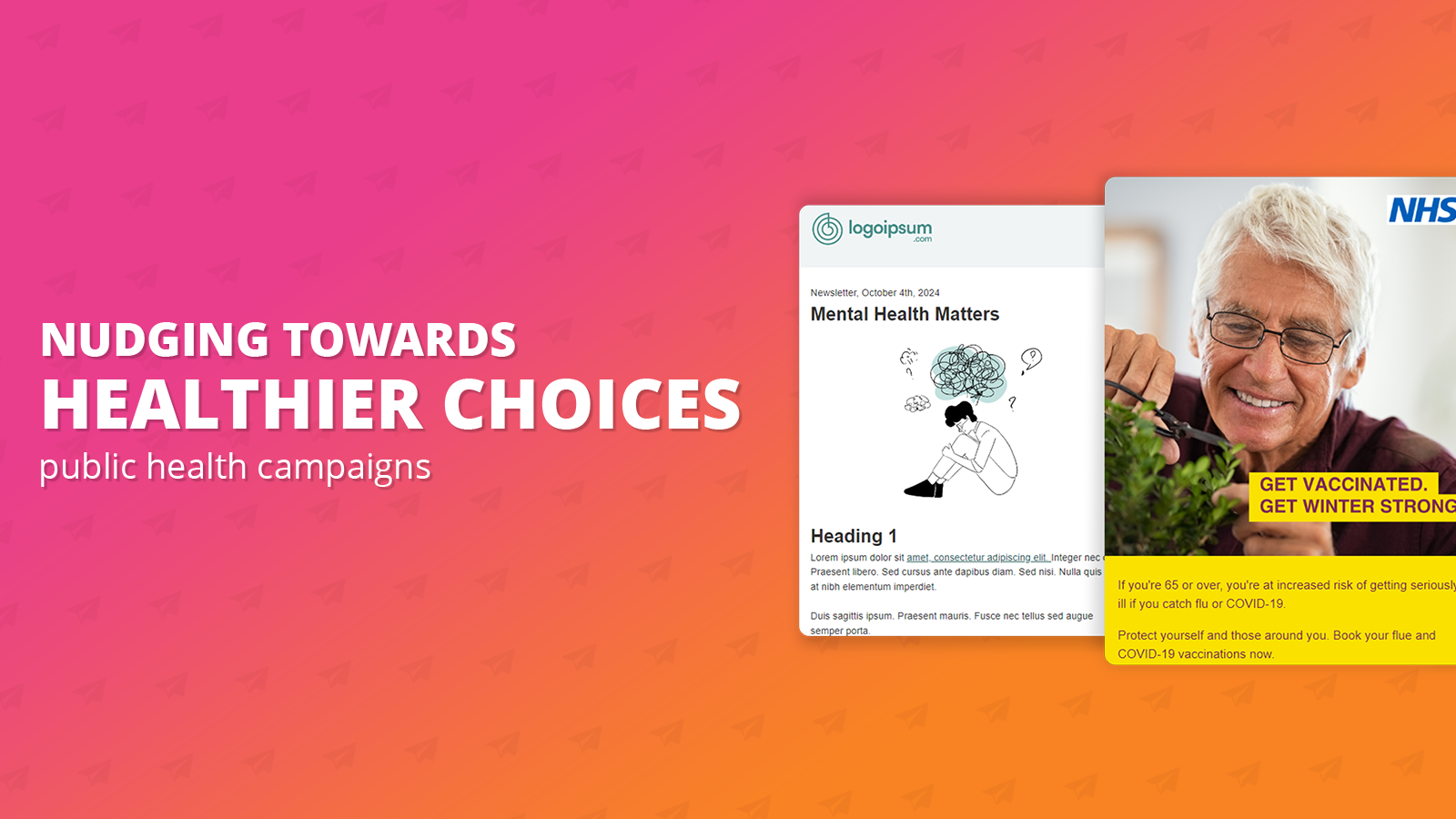
Nudging toward Healthier Choices
October 4th, 2024 - Harry Thomas
In the world of public health communications, influencing behaviour is critical for successful campaigns. Whether you're encouraging healthier...
Social media Best practice Design
Social Share – how to grow your email audiences organically
April 17th, 2026 - Harry Thomas
Social sharing is a way of building communities and driving engagement online, allowing you to reach wider audiences organically. Social sharing...
Solutions

Email Marketing
Create email campaigns and newsletters and manage end-to-end subscription processes with forms and preferences.

Marketing Automation
Create sophisticated automated campaigns for email and SMS combined.

Digital Communication
The comprehensive solution to manage and automate your digital communication across email, SMS, websites and landing pages.

Email marketing healthcheck
We are confident that we can help you, which is why we offer a free healthcheck to identify potential issues with your current programme and free advice on things that could be done to improve it.