Blog
CATEGORY: Best practicePublic Sector
Best use of email for 2025

It was our second year judging the category of “Best use of email” at the UnAwards this year and we were delighted that along with 2024 being a record-breaking year in terms of entrant numbers, the email category saw;
an increase in entry numbers,
a number of entries specifically and only for the email category,
entries focusing on the “best use of email” within fantastic omnichannel campaigns,
entries looking at the “best use of email” and developing it into a highly effective channel strategically employed to support all comms and not just individual campaigns.
Whilst there were moments when judging that these two alternative ways of looking at the “best use of email”, felt like trying to compare “apples with oranges”, “strategy vs tactics” even “outcomes vs outlooks” we were delighted to see that the industry as a whole is re-engaging with email as a highly effective channel.
In the private sector email has held centre stage and the best marketing channel for many years, consistently demonstrating excellent ROI – figures remain fairly consistent around £42 return on every £1 spent on email marketing. Far outperforming out-of-home and broadcast media and more costs effective (but no less direct) than direct mail.
The direct nature of email, as an owned channel, also makes it outperform organic social media where you are at the behest of algorithms which continue to erode audience reach and opportunities to see your messaging. And there is a lot to be said, just think how social channels look to reengage you if they think you have not been active enough recently – that’s right…. They send you an email….
Email is a powerful and multi-facetted channel, be it a central newsletter acting as the backbone of the regular comms arsenal or a multistep campaign journey with a determined number of steps to progress a recipient through a journey to a desired outcome – be that education or understanding, behaviour change or simply removing pressure from other overstretched or expensive resource – looking at email’s strategic role as well as its tactical benefits will help local authorities immeasurably.
Unawards winners Surrey County Council are currently on this journey,
“Surrey’s use of email stands out from the other entrants both in terms of its ambition and achievement. Others focussed on a single email or campaign, whereas Surrey’s entry represented a unified strategy for email based on customer feedback. Giving customers information that they’ve asked for seems a simple concept, but the effectiveness of this approach is borne out in the numbers. 979% increase in subscribers. Click-through rates higher than many achieve as an open rate.”
What do you need to consider for “best use of email” in 2025
Hyper-Personalisation and AI Integration
Personalisation has long been a cornerstone of effective email marketing, but by 2025, hyper-personalisation driven by artificial intelligence (AI) and machine learning (ML) will become the norm. AI algorithms are improving in their ability to analyse vast datasets and predict user preferences, enabling marketers to craft hyper-relevant messages tailored to individual behaviours, demographics, and interests.
Dynamic Content: AI-driven dynamic content will allow emails to change in real-time based on user behaviour or data triggers.
Predictive Analytics: Tools will anticipate what content or offers a recipient is likely to engage with, optimising email frequency, send times, and subject lines for each user.
AI-Powered Copywriting: Generative AI tools will assist marketers in crafting compelling email copy that aligns with recipient personas.
Increased Automation and Intelligent Workflows
In 2025, automation will go beyond basic drip campaigns. Intelligent workflows will leverage real-time data to create seamless, automated journeys that span multiple touchpoints.
Behaviour-Triggered Emails: Automated messages based on user actions (website visits, app usage, previous email interactions) will increase engagement.
Cross-Channel Automation: Integrated marketing strategies will ensure email campaigns work in tandem with SMS, social media, and push notifications, offering consistent messaging across platforms.
Lifecycle Marketing: Automation will be crucial in nurturing leads, onboarding customers, and maintaining long-term relationships with clients through thoughtful, automated communication flows.
Enhanced Privacy Regulations and Compliance
As data privacy remains a key concern, regulations like the GDPR, and emerging laws worldwide will continue to shape email marketing practices. By 2025, email marketers will need to prioritise data compliance and ethical practices.
Zero-Party and First-Party Data: Marketers will focus on collecting data directly from consumers through surveys, preference centres, and interactive content, reducing reliance on third-party data.
Privacy-Conscious Engagement: Transparent communication around data usage and obtaining explicit consent will become non-negotiable.
Email Authentication Standards: With increasing threats of phishing and spoofing, authentication protocols such as SPF, DKIM, and DMARC will also be non-negotiable.
Interactive and Immersive Emails
Email is no longer just static text and images. Interactive and immersive elements will create engaging, web-like experiences directly within the inbox.
AMP for Email: Accelerated Mobile Pages (AMP) will allow recipients to complete actions like RSVPing for an event, submitting a form, or browsing product categories without leaving the email.
Gamification: Including elements like quizzes, polls, or scratch-to-win promotions can boost engagement and click-through rates.
Video and Rich Media: Improved support for video and rich media will make emails more visually engaging and help convey complex messages succinctly.
But..
Inbox Overload and Attention Scarcity
The volume of marketing emails continues to rise, and recipients’ inboxes are more crowded than ever. Cutting through the noise and capturing attention will be increasingly challenging.
Deliverability Concerns: More emails mean stricter filters and higher competition for inbox placement.
Engagement Drop-off: As users are bombarded with messages, maintaining high open and click-through rates will require more strategic, high-value content.
Technological Fragmentation
With numerous email clients, devices, and operating systems, ensuring emails display correctly across platforms will remain a challenge. Responsive design and accessibility best practices will be critical.
Dark Mode Compatibility: As more users adopt dark mode on their devices, ensuring emails look good in both light and dark settings will be important.
Accessibility Standards: Crafting emails that are accessible to users with disabilities (e.g., screen-reader-friendly) will be essential for inclusivity.
Data Privacy and Tracking Limitations
New privacy-focused policies and tech changes, such as Apple’s Mail Privacy Protection (MPP), reduce marketers’ ability to track email open rates and other metrics accurately.
Shift to Engagement Metrics: Marketers will need to rely more on clicks, conversions, and customer feedback instead of open rates.
Anonymised Data Management: Strategies for handling anonymised or aggregated data without compromising insights will become crucial.
In 2025, email marketing remains a cornerstone of digital communication, offering stability and control that other channels lack. By embracing AI-driven personalization, automation, and interactivity while navigating privacy and accessibility challenges and changing social media dynamics, email professionals can ensure their strategies remain impactful. Focusing on value, relevance, and ethical practices will allow brands—especially those in the public sector—to stand out, build trust, and achieve lasting engagement.
You may also like these blogs
Social media Best practice Design
Social Share – how to grow your email audiences organically
April 17th, 2026 - Harry Thomas
Social sharing is a way of building communities and driving engagement online, allowing you to reach wider audiences organically. Social sharing...
5 ways email can be used to promote local elections
February 16th, 2026 - Harry Thomas
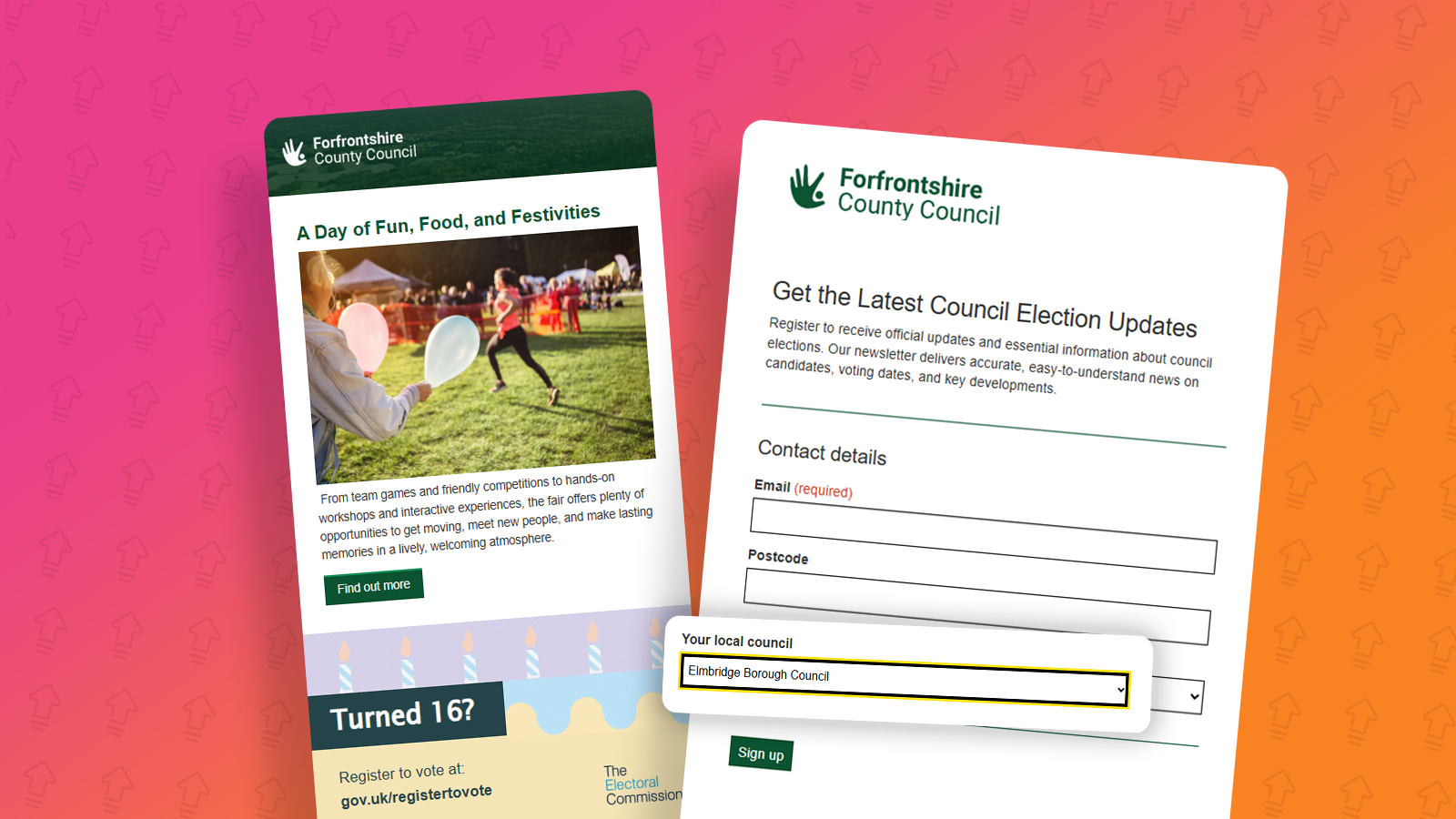
Local elections suffer without direct contact. During campaigns, crucial information doesn’t reach the right people, confusion grows, and turnout...
Public sector email benchmarks for 2026
January 5th, 2026 - Harry Thomas
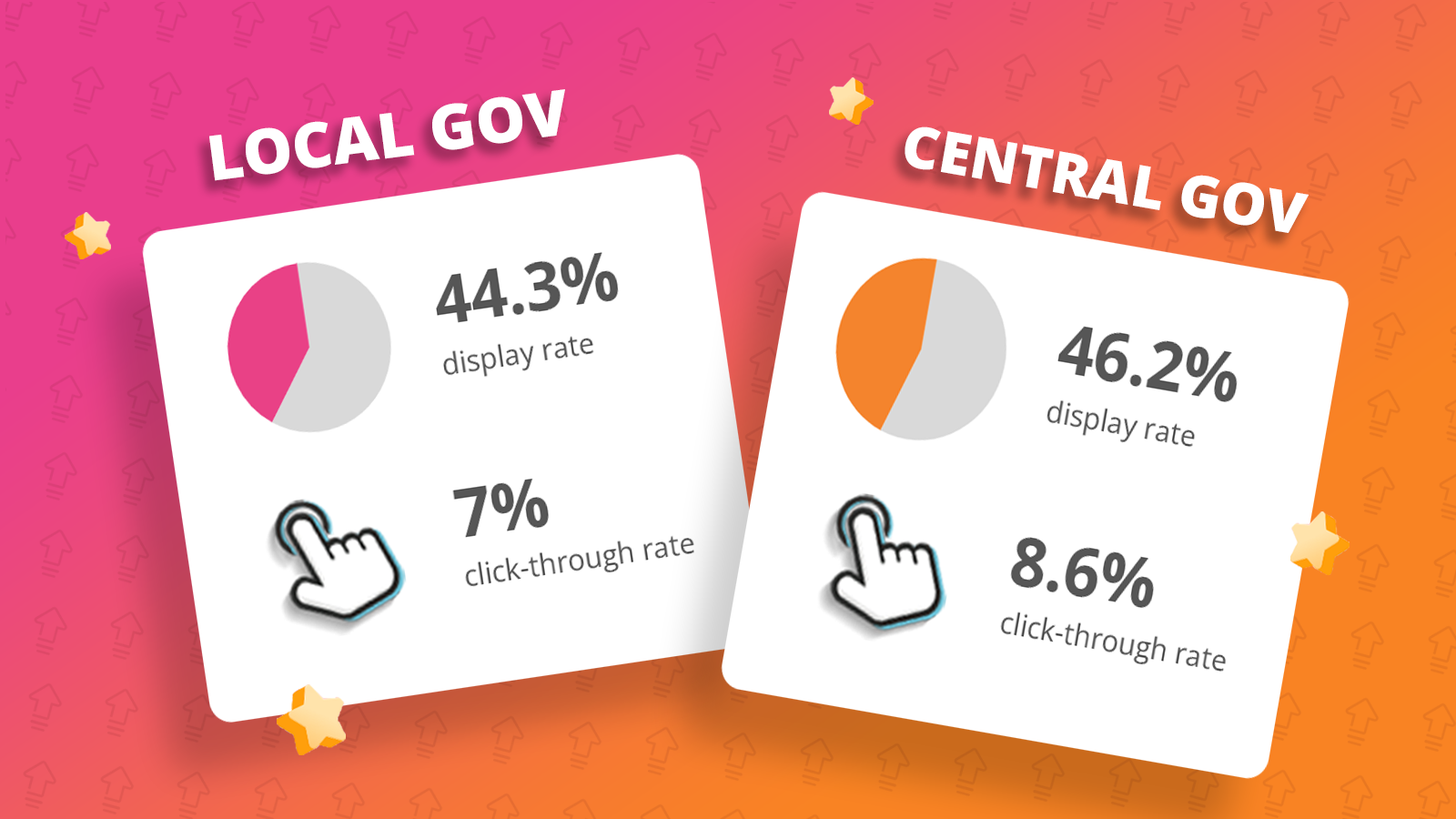
What the data from 300 million public sector emails sent last year shows us (and what it doesn’t) This report summarises the 2025 performance over...
Solutions

Email Marketing
Create email campaigns and newsletters and manage end-to-end subscription processes with forms and preferences.

Marketing Automation
Create sophisticated automated campaigns for email and SMS combined.

Digital Communication
The comprehensive solution to manage and automate your digital communication across email, SMS, websites and landing pages.

Email marketing healthcheck
We are confident that we can help you, which is why we offer a free healthcheck to identify potential issues with your current programme and free advice on things that could be done to improve it.