Blog
CATEGORY: Public SectorResources
Public sector email benchmarks for 2026
What the data from 300 million public sector emails sent last year shows us (and what it doesn’t)
This report summarises the 2025 performance over a very large sample of campaigns sent by public sector organisations that use the e-shot platform to send email to subscribed lists.
You can use it to set pragmatic expectations for 2026 and if you are an e-shot customer, you can also use it against your own account review data.
Email benchmark results
| 2025 averages | Unique click rate | Display (open) rate | CTOR | Average Volume |
|---|---|---|---|---|
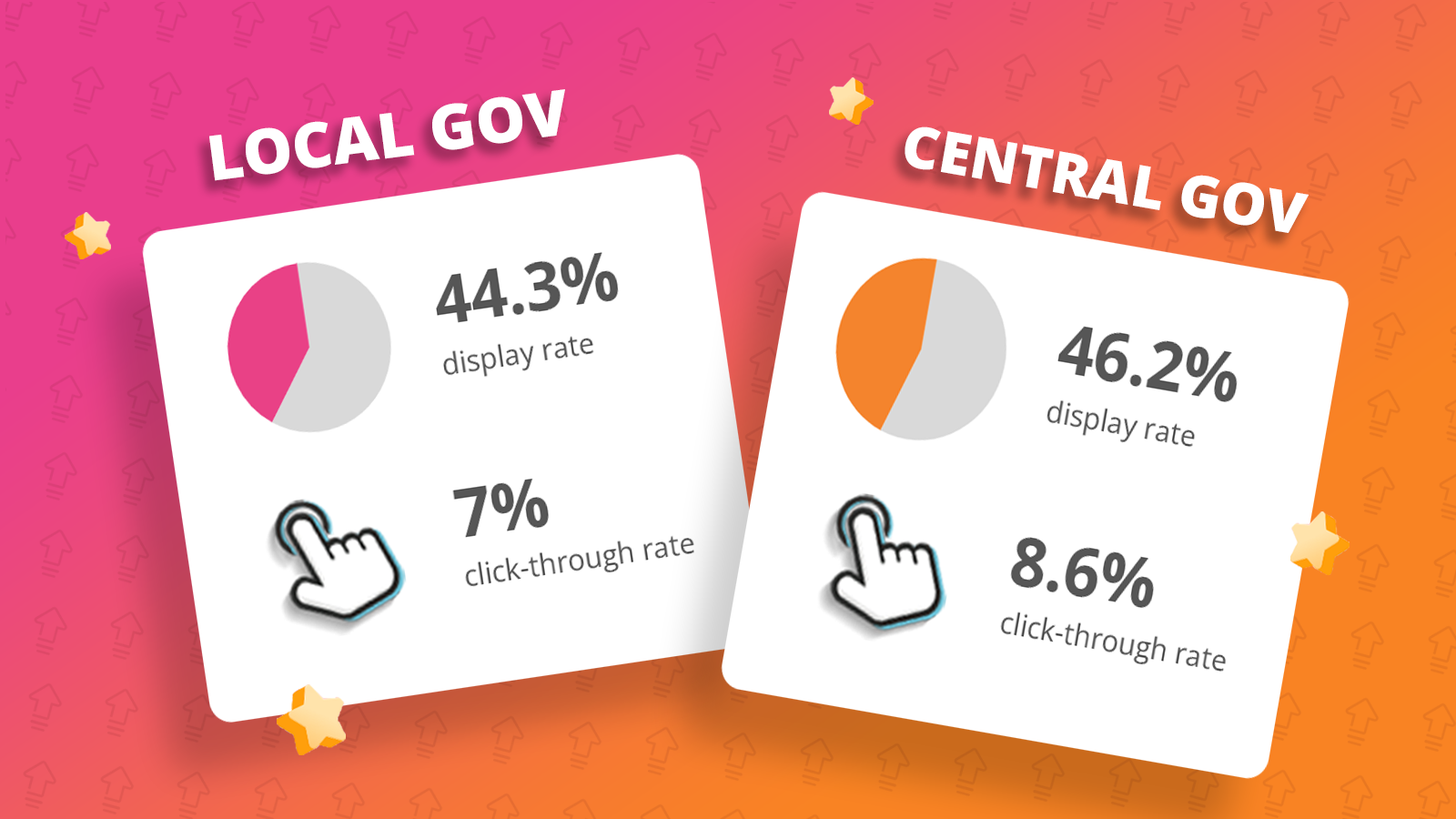
| Overall | 6.4% | 45.0% | 14.9% | 648,065 |
| Government | 6.0% | 45.5% | 17.4% | 978,035 |
| Local authority | 6.1% | 44.1% | 14.2% | 577,910 |
| DMA Benchmark | 2.3% | 35.9% | N/A | N/A |
*CTOR = Click to open rate. The percentage of unique clicks on links within an email compared to the total number of unique opens, focusing on engagement after the email is opened.
Average Volume = Average amount of emails sent in 2025 per sub-account.
About the data
The above figures are median averages.
The overall figures include data for a broad range of public sector organisations including ministerial departments, councils, public bodies, NHS trusts, NHS ICBs, emergency services, and housing associations in the UK.
The Government benchmark includes data from ministerial, non-ministerial departments and public bodies from England, Wales, Scotland and Northern Ireland.
The Local Authority benchmark includes data from county councils, district and borough councils, London boroughs, unitary authorities, and metropolitan districts in England.
The DMA Benchmarks are from the DMA’s Email Benchmarking Report 2025. e-shot is a DMA member and holds the DMA Dataseal accreditation.
The median average ensures that figures are not skewed by the extremes, but if we look at the top performers, then there is a clear difference between those who are doing it very well and the rest.
| 2025 top 10% | Unique click rate | Display (open) rate | CTOR | Average Volume |
|---|---|---|---|---|
| Overall | 18.0% | 73.6% | 38.3% | 4,226,667 |
| Government | 21.3% | 77.3% | 39.3% | 7,520,586 |
| Local authority | 17.8% | 72.7% | 39.7% | 3,357,102 |
| DMA Benchmark | 2.3% | 35.9% | N/A | N/A |
What these benchmarks show us
It is encouraging to see the public sector outperforming the private sector and this is consistent with previous years analysis. Public sector organisations tend to have more robust information governance in place to ensure audiences only receive granular communications for which they have given consent. They also tend to send more information-based emails, whereas most private sector emails have a commercial focus.
The top 10% enjoy fantastic and consistent levels of email engagement that drive significant volumes of traffic to the content shared in them. When we look at those in that top performing group, we see they consistently employ best practices with regular list hygiene, subject line optimisation and clear, accessible content.
Even outside of the top 10%, email represents a highly effective channel that consistently draws attention and interest to content.
Why benchmarks help (and why they’re vanity metrics)
Benchmarks are useful for spotting issues - e.g., if your click rate collapses while volumes rise, or if one segment suddenly underperforms the rest. But they also drift into vanity when teams chase “a good open rate” instead of proving whether the programme drove outcomes (registrations, enquiries, bookings, service uptake, etc.).
We tend to recommend using benchmarks to identify where your own programme may need investigation and improvement rather than as a definition of success.
What really drives performance
The biggest lever is the quality of the subscriber database: how people joined, whether they expected your emails, how current the addresses are, how well you suppress disengaged recipients, and whether you respect preferences - these factors can affect deliverability and downstream engagement before your design and copy even gets a chance to shine.

Your own benchmarking
Trendline analysis is usually more useful than notional benchmarks: a steady rise in click rate over six months after list cleaning and better segmentation tells you more than whether you’re above or below an industry average on a random quarter. That’s also why internal baselines are often more useful than generic benchmarks for decision-making.
Email is an attention and intent channel; the more meaningful measurement happens after the click. Consider the real-world impact of your campaigns and judge campaign effectiveness on what the email caused beyond the click:
Form fills and registrations tied to specific email content
Key journeys: downloads, registrations, quote requests, appointment bookings, and other goal completions
Website sessions and engaged sessions attributed to email (by campaign + by group or preference)
Assisted conversions (email as a first touch vs last touch point)

Why display (open) rates remain unreliable
Displays (opens) are an estimate, not a ground truth, because opens are typically inferred when a tracking pixel loads—and privacy/cybersecurity controls can trigger that pixel without a human reading the email, or block it even when a human does read it. The DMA noted in its own benchmarking survey that post–Apple Mail Privacy Protection, opens became less reliable due to auto-generated “fake opens” designed to obscure real user activity. That creates a margin for error in both directions:
False positives: automated prefetching/proxying can record an “open” that was never a real read.
False negatives: image blocking or security tools can prevent the pixel loading even if the message was genuinely viewed.
Clicks and conversions are generally more reliable, which is why many teams treat click and post-click activity as sturdier indicators of real engagement.
What else to look out for in 2026
AI enabled inboxes
As AI adoption for daily tasks increase, a growing number of emails will be summarised by AI rather than presented to the recipient in the traditional format. Tools to filter and highlight important messages are already widely available in major email clients including Gmail and Outlook. In line with current best practice advice, it will be increasingly important to optimise subject lines and preview text, whilst ensuring key information is presented succinctly at the top of the email. Accessibility best practices also apply as AI tools read emails in a non-visual way.
Deliverability is getting stricter
Mailbox providers have improved their cybersecurity stance, with stricter authentication and spam filtration based on user behaviour rather than older, content-based filtering.
Gmail and Yahoo now reject bulk emails from senders who fail authentication, exceed spam thresholds, or do not support one-click unsubscribe. Many email programmes still lack these vital components.
Email as a component of omnichannel experiences
Although the public sector may lag consumer brands, there is an increased focus on customer experience and managing communications across multiple touchpoints and channels. e-shot data is increasingly being used in tandem with other data sets through integrations and data warehousing. This creates new and exciting opportunities to conduct intelligent omnichannel campaigns that can drive behaviour change and other strategic outcomes.
Lighter design
Mobile responsiveness has been a factor in email design for a long time, but there is growing need to optimise the whole user experience to a mobile audience. Shorter emails where design components do not disrupt the user experience tend to enjoy better response rates. These simplicity principles are also a consideration for accessibility and for AI-enabled inboxes. Large, memory heavy emails also have a increased carbon footprint.
The functional efficiency of best practices, like those commonly demonstrated in the GOV.UK design system, can deliver improvements in user experience, accessibility and environmental impact.
You may also like these blogs
.png)
How Local Authorities use storytelling and email to drive real-world change
November 4th, 2025 - Harry Thomas
In the ever-crowded world of public sector communications, facts alone aren’t enough to capture attention—especially when you’re competing with the...
The media estate - Why build an owned audience
July 9th, 2025 - Harry Thomas
The media estate - Why build an owned audienceIn today’s digital-first world, public sector organisations must reach and engage diverse communities...

Pop-ups: From Passive Browsing to Purposeful Action
May 1st, 2025 - Jakub Gacon
Pop-ups have come a long way from their clickbait origins. When used with intention and purpose, they can play a vital role in helping public...
Solutions

Email Marketing
Create email campaigns and newsletters and manage end-to-end subscription processes with forms and preferences.

Marketing Automation
Create sophisticated automated campaigns for email and SMS combined.

Digital Communication
The comprehensive solution to manage and automate your digital communication across email, SMS, websites and landing pages.

Email marketing healthcheck
We are confident that we can help you, which is why we offer a free healthcheck to identify potential issues with your current programme and free advice on things that could be done to improve it.