Blog
CATEGORY: Public Sectordigital-marketing
Introducing AI into Local Authority comms workflows
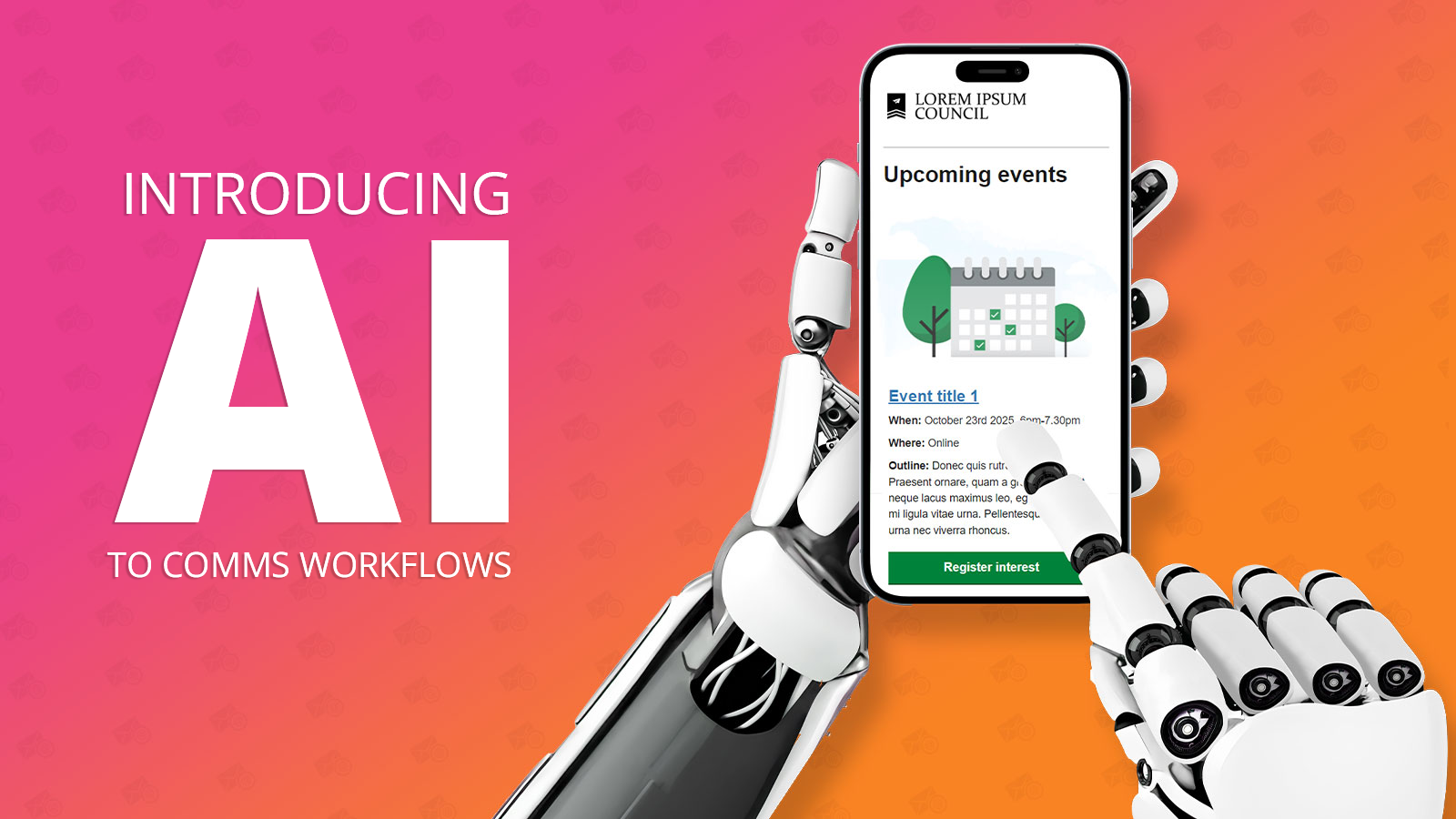
Let’s face it, AI is everywhere: Google, Outlook, Mailchimp, Meta, LinkedIn, and now even IOS. Since AI integration is already underway, the best you can do is learn as much as you can about the tools relevant to your role and that will best serve you as you serve your citizens.
Over the past 12 months, like most industries, local government has decided that artificial intelligence (AI) is a technology that we should be paying immediate attention to.
Since the White Paper was published in late March, there has been considerable public interest in generative AI, and reports of changes to the government’s position.
Generative AI is a broad label used to describe any type of artificial intelligence (AI) that can be used to create new text, images, video, audio, or code. Large Language Models (LLMs) are part of this category of AI and produce text outputs.
ChatGPT and Google’s Bard are publicly available web-based versions of generative AI, that allow users to enter text and seek a view from the system, or to ask the system to create textual output based on a given subject. They allow individuals to summarise long articles, get an answer of a specific length to a question, or have code written for a described function.
Large language models (LLMs) and AI chatbots have captured the world's interest, ignited by the release of ChatGPT in late 2022 and the ease of querying it provides. It's now one of the fastest growing consumer applications ever, and its popularity is leading many competitors to develop their own services and models, or to rapidly deploy those that they’ve been developing internally.
LLMs are undoubtedly impressive for their ability to generate a huge range of convincing content in multiple human and computer languages. However, they’re not magic, they’re not artificial general intelligence, and contain some serious flaws, including:
they can get things wrong and ‘hallucinate’ incorrect facts
they can be biased, are often gullible (in responding to leading questions, for example)
they require huge compute resources and vast data to train from scratch
they can be coaxed into creating toxic content and are prone to ‘injection attacks’
Generative AI is optimised for plausibility rather than accuracy, and therefore should not be relied on as the sole source of truth, without additional measures to ensure accuracy.
The NCSC sum this up nicely “In their current state, LLMs suffer from appearing convincing (whether or not they are), and are suited to simple tasks rather than complex ones. This means LLMs are useful for 'helping experts save time', as the expert can validate the LLM's output.”
Generative AI should not be used in high 'explainability' contexts – the inner workings of an AI solution may be difficult, if not impossible, to explain, therefore should not be used where it is essential to be able to explain each step in the decision-making process.
The performance of generative AI depends on large quantities of training data. Systems that have been trained on limited data or for specialist fields may produce “bias” or inaccurate results.
So that covers where AI may not be the best option, however to deny the many considerable advantages that it can provide would be foolish.
So how can AI be reasonably brought into local authority comms workflows to bring benefit to the user?
Content creation
Ideation: AI powered tools can be useful to help spark imagination, similar to the experience of brainstorming with a group. Effectively giving you a start point so you are not faced with a glaring blank page.
Writing Assistance: AI-powered writing tools (e.g., Grammarly, Jasper) can help create and edit press releases, newsletters, and social media content, ensuring clarity and correctness.
Content Personalization: AI can analyse audience data to tailor content to different segments, improving engagement.
Accessibility Improvements
Language Translation: AI-powered translation tools can help communicate with non-English speaking residents, ensuring inclusivity.
Voice Assistants: Implement AI-driven voice assistants on websites to aid those with visual impairments or other accessibility needs.
Enhanced Collaboration
AI-Powered Collaboration Tools: Tools like Slack or Microsoft Teams integrated with AI can streamline communication within teams, manage projects, and automate routine updates.
Meeting Summaries: AI can transcribe and summarize meetings, ensuring that important points and action items are captured accurately.
Diversity and Inclusion
Bias Detection: AI can help identify and mitigate biases in communication materials, ensuring that content is inclusive and representative of the diverse community.
By integrating AI into their workflows, local authority communications professionals can not only streamline their operations but also enhance their ability to connect with and serve their communities more effectively. This approach leads to more informed, responsive, and efficient communication strategies that can better meet the needs of the public.
9 Top tips (provided by ChatGPT)
1. Be Clear and Specific
Clear Questions: Formulate your questions or requests as clearly and specifically as possible. Avoid vague terms.
Specific Instructions: Provide detailed instructions on what you need. For instance, specify the type of information or the format you want the answer in.
2. Context is Key
Background Information: Provide relevant background information if your query is complex. This helps the model understand your needs better.
Follow-Up Context: When asking follow-up questions, reference your previous questions or responses to maintain context.
3. Use Proper Prompts
Role-Playing Prompts: Use prompts that define roles i.e "Act as a tutor and explain etc" This can guide the model to provide answers in a desired style or tone.
Scenario-Based Prompts: Describe scenarios or situations in detail to get more tailored responses.
4. Iterative Refinement
Follow-Up Questions: Don't hesitate to ask follow-up questions if the initial response isn't satisfactory. Clarify what you need or ask for more details.
Refinement: Refine your prompts based on the responses you receive. Adjust the questions to better align with the information you're seeking.
5. Ask for Examples
Practical Examples: Request examples to clarify complex concepts. For instance, "Can you give an example of how this works?"
Sample Scenarios: Ask for sample scenarios or case studies to understand applications better.
6. Leverage Formatting
Bullet Points: Request information in bullet points for clarity and easy reading.
Tables and Lists: Ask for data in table or list format for better organization.
7. Limitations and Verifications
Fact-Checking: Verify the information from credible sources, especially for critical or factual data.
Awareness of Limitations: Understand that ChatGPT may not always provide accurate or up-to-date information. Use it as a starting point for research.
8. Creative and Analytical Uses
Brainstorming: Use ChatGPT for brainstorming ideas or creative writing prompts.
Problem Solving: Engage in problem-solving discussions or seek analytical perspectives on issues.
9. Feedback and Interaction
Feedback Loop: Provide feedback on responses to help the model improve. Highlight what was useful or suggest areas for better clarity.
Interactive Engagement: Treat the interaction as a conversation, building on previous responses to deepen the discussion.
By applying these tips, you can enhance your interactions with ChatGPT, making it a more effective tool for your needs.
You may also like these blogs
AI in email marketing
March 19th, 2024 - Jakub Gacon
While AI brings the potential of endless and sometimes game-changing possibilities to email marketing, it also comes with some risks and should be...
Solutions
Email Marketing
Create email campaigns and newsletters and manage end-to-end subscription processes with forms and preferences.

Marketing Automation
Create sophisticated automated campaigns for email and SMS combined.

Digital Communication
The comprehensive solution to manage and automate your digital communication across email, SMS, websites and landing pages.

Email marketing healthcheck
We are confident that we can help you, which is why we offer a free healthcheck to identify potential issues with your current programme and free advice on things that could be done to improve it.