Case Study: Gambling harms email campaign
When the adverts stop, the support carries on
The 2026 World Cup was hosted across North America. For anyone watching in the UK, that meant kick-offs between 6pm and 3am across 104 matches, many of them long after most households had gone to bed. People often watched alone, at home, with a phone in their hand. For anyone vulnerable to gambling harm, that combination was a particular risk.
Every one of those matches arrived wrapped in betting advertising. Odds on the television, in-play offers in people's feeds, free bets and odds boosts landing at exactly the moment someone was most likely to act on them. High-risk gambling searches already peak between 11pm and 4am. This tournament put the temptation, the isolation and the sleeplessness in the same place for eight weeks.
Odds Are: They Win asked the people most at risk of gambling harms to do something difficult: to recognise that risk themselves, in the middle of all the noise and temptation, and take the first steps towards seeking support. It offered a clear alternative to the isolation and pressure those suffering from gambling addiction report, letting them know they are not to blame and signposting them to free, confidential support.
Thrive LDN, the North Central London Tackling Gambling Harms Coalition, other London councils and several councils across England ran the campaign. CAN Digital led the paid media that generated awareness and drove response. e-shot built the automated email programme that picked people up at the point of interest and stayed with them.
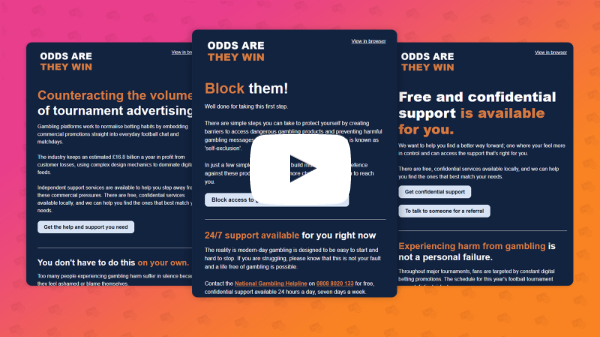
One click on a social advert, then an email address. From there, an automated sequence supported residents through the late-night kick-offs of the tournament, pointing them to the help available where they lived.
The campaign model was first proven in Greater Manchester in 2022 and evaluated strongly. For 2026, partners added the piece the pilot never had: a way, through email, to hold on to the people the advertising reached.
Challenges
Help had to be there at the wrong time of day. The risk peaked in the small hours, when no service is staffed and no one is checking a campaign inbox. Support that was only available during the working day was going to miss the moment entirely. Whatever the campaign did next had to run itself, reliably, at 1am on a Saturday night.
Advertising creates a moment. Something has to carry it forward. The gambling industry spends around £2 billion a year marketing to people in the UK, and during televised football that can mean an advert every ten seconds. The campaign's paid media worked hard against that level of spend to generate real responses. But an impression, by its nature, is a single moment. Gambling harm plays out over months.
The harm does not stay in one place. Gambling harm rarely arrives on its own. It can create pressures on finances leading to debt, strains on relationships, on mental health, difficulties at work and with housing. A person who signs up for help with gambling addiction may be dealing with several of those pressures at once, and the support they need is rarely held by a single service. Any campaign signposting support had to recognise that.
The 2022 pilot had nowhere to put the response. It drove more than 16,000 unique clicks to its landing page. Every one of those people showed a flicker of interest, and then went back into the feed, becoming unreachable. When the media spend stopped, the relationship stopped.
Partners needed a channel that worked at 1am, cost very little per contact, and outlasted the tournament.
"Building trust across London's diverse boroughs requires more than a single campaign push. Sustained, localised contact allows us to maintain an ongoing conversation, ensuring we are offering the right support at the right time, rather than simply broadcasting general advice."
James Ludley, Programme Manager, Thrive LDN
How e-shot™ helped
e-shot is an email marketing and automation platform built for UK public sector organisations, and used by councils, NHS trusts and housing associations.
Email is the most personal and trusted digital channel most people have. Although it can be used as a mass communication tool, it is most effective when the message is highly targeted.
We built the sign-up around best practice, so that people seeking help for gambling harms could opt in to receive support by email. That mattered for this campaign, because it gave people agency to opt in and out while leaving the partners, not a social media platform, holding the relationship with someone seeking help. Paid media and email were designed to work together: one to reach people, one to stay with them.
Here is how the programme worked.
A two-field front door
Residents who clicked a campaign advert gave an email address and a postcode. No account, no forms to wade through, and a clear route out at any time. Two fields is all it took, and low friction at sign-up is what turns advertising response into an actual contact.
Repeated touchpoints, timed to the risk
Addiction is not broken in a single moment, so a single email would not have had sufficient impact. We built a sustained email sequence and scheduled it around the high-risk windows of the tournament, so messages landed when the urge to bet was strongest rather than when it was convenient to send. Automation made that possible without anyone staffing a send button at midnight.
Local support, on a local page
Each partner had a dedicated landing page of their own, setting out the support available in their area alongside national services where local provision was thinner. The emails directed people to these pages. The landing pages often went beyond gambling-specific support to signpost, where local provision allowed, other services including debt advice, mental health and housing support.
Practical off-ramps, not lectures
The email sequence guided people towards small pieces of environmental friction they could set up in minutes: bank gambling blocks, URL blockers, deposit limits. It also addressed the addictive design of gambling products and disrupted industry tactics, rather than placing blame on the individual.
Data the partner keeps
With consent captured properly from the outset, partners finished the campaign holding an engaged, permission-based audience, not a list that expired with the media buy. They can now reach these residents through local gambling support and offer advice on the complex issues people living with addiction face.
One programme, many places
The same core programme served partners in eight areas at once, from London boroughs to county councils, with the emails adapted to reflect the support that each area could offer. None of them needed to build or run a programme of their own.
A tone people could accept
The sequence was written in partnership with behavioural specialists and with people who have lived experience of gambling harm. The emails focused on the strategies the gambling industry uses: free bets and odds boosts, a loss rebranded as a 'near miss', and the design choices inside apps and betting platforms that keep people playing.
The messaging within the email sequences was key, because someone who already feels ashamed will not open a message that confirms it. The emails set out how the industry works, plainly and without judgement, rather than suggesting that a person simply lacked the willpower to resist betting.
Results, ROI and the future
The tournament gave the campaign a reason to exist and a moment to launch into. It set out with two distinct objectives. The first was to reach people at scale while the football was on, measured through the reach and impressions delivered by paid media, which count opportunities to see the campaign. The second was to give the people who responded somewhere to go for support from public health teams. Sign-ups have continued to arrive since the tournament ended.
The two sets of figures below answer different questions, because the channels were doing different jobs. One is a much larger number by design to ensure reach; the other focuses on created the conditions for sustained engagement.
Reach and awareness
Paid media ran from 5 June to 29 July 2026, led by CAN Digital.
3.7m people reached
27.3m impressions
164,630 clicks
Solutions
Email Marketing
Create email campaigns and newsletters and manage end-to-end subscription processes with forms and preferences.
Marketing Automation
Create sophisticated automated campaigns for email and SMS combined.
Digital Communication
The comprehensive solution to manage and automate your digital communication across email, SMS, websites and landing pages.

Email marketing healthcheck
We are confident that we can help you, which is why we offer a free healthcheck to identify potential issues with your current programme and free advice on things that could be done to improve it.